
Soldiers in the Civil War
This is the section of the web site that deals with our citizens who served in the Civil War. We include those who were born in the county, enlisted here, came here after the War or are buried here. Some may have actually been citizens of what is now Mineral County, but was Hampshire County then.
- Colonel Robert White
- Maj. John B. Sherrard
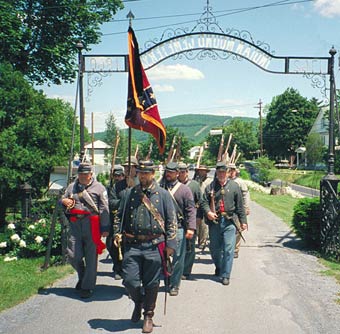
- Capt. Turner Ashby
- Lt. John Blue, the "Hanging Rock Rebel" obituary
- Capt. Bartlett of Imboden's command, killed July 3, 1864 at Hanging Rock. [This individual is not listed on the Confederate Monument; his name appears on notes about a cemetery along North River on the former Pepper and Lincoln Cox property. We would appreciate any information on this individual.]
- Capt. J. M.. Lovett
- Capt. G. F. Sheetz
- Capt. A. Smith
- Capt. Simon W. Swisher
- Capt. George W. Stump
- Captain C. S. White
- Lt. Alexander White
- Col. Angus McDonald
- Captain John Hanson McNeill
- Lt. Jesse McNeill
- Capt. George F. Sheetz
- Capt. E. H. Shans
- A. W. Pownall, Romney Veteran
- Henry Wilson according to a speech by Col. C. S. White in the Review of Sept. 3, 1885, was "the first of Hampshire's sons who gave his life to the Southern Cause." [Yesterday's Review, May, 1998, vol II, no. 3]
- John W. Starnes of Springfield; His story was published in 1904 in the March 9th and 16th editions of the Hampshire Review. He was the son of Frederick and Ann (Haines) Starnes and lived apparently near Hanging Rocks on the South Branch. He enlisted on September 14, 1861. Mr. Starnes died May 23, 1922 at the age of 77. We expect to publish a longer article on him in the near future; please check back.
- George Sloan Arnold, a member of Company A, 33rd Virginia Regiment, Stonewall Jackson Brigade, died at his home, Hampshire County, W. Va., on January 6, 1924. He was born in the same house on January 1.1, 1843. He joined the Confederate army in 1862 and served throughout the war. He was a volunteer with McNeil's Rangers when they captured Generals Crook and Kelly in Cumberland, Md. He was on mounted dispatch duty for quite a while in the lower Shenandoah Valley and in the latter years of his life often related his experiences in delivering dispatches to General Lee. Comrade Arnold was married to Miss Virginia Parsons in June, 1882, and he survived her by some twenty-two years. Their four children survive him.
After the war his life was devoted exclusively to farming, and he was regarded as a very modest, energetic, and successful man of the community in which he lived. [The Confederate Veteran, Vol. 32, 1924] - Edward Bretsford, farmer, but formerly a blacksmith, son of Jesse and Mary E. Bretsford, was born 1838; French ancestry; married, 1872, to Barbara, daughter of Mr. and Mrs. Swancy, of Maryland; children, Edward E. and John M. Mr. Bretsford owns four hundred and eight acres, forty improved; was a Confederate soldier twelve months, and lost an arm from a wound received while on furlough, near Slanesville.
- John Daileyof Springfield (Apr. 16, 1829-Jan 15, 1911) at Springfield; Merchant; Enlisted 4/1/1862 in Co D, “McDonaId’s” 11th Virginia Cavalry, CSA, at Harrisonburg; POW 9/28/64 at Springfield; sent to Cumberland, Md. in the local jail until 10/24/64; Transferred to Atheneum Prison, Wheeling but jumped through the railroad car window handcuffed and hobbled and escaped at Piedmont; RTD and was in the raid to Cumberland that captured Generals Crook and Kelly 2/21/65; Paroled 5/10/65 at Romney; buried Springfield. Note: reference at West Virginia University Library - Daily, John (1829-1911). Typescript, 1861-1911. No. 352. This document primarily describes the Civil War service of John Daily (born in Springfield, in Hampshire County) with the 11th Virginia Cavalry, C.S.A.
- Stephen Hannas, one of the best-known men of his county, died at his home, near Romney, W. Va., on December 29, 1912, in his seventieth year. During the war he served as a member of Company D, 11th Virginia Cavalry, commanded by Maj. E. H. McDonald; and he was the third of that command to die within three month. He was member of Camp Hampshire, U. C. V. His wife, three sons, and four daughters survive him. [Confederate Veteran vol 21, p. 298]
- Charles P. Johnson was born March 22, 1844, in Hampshire County, Va., joined Company B, 11th Virginia Cavalry, C. S. A., March 1, 1862, and was mustered out of service at Fort Delaware June 13, 1865. He was one of the six hundred sent to Charleston and held under fire of the Confederate guns for three weeks; was with Stewart's Cavalry in all the battles about Richmond. Comrade Johnson died at his home in this city October 26, 1919. A splendid man, a Christian gentleman, he died fully in the faith and has gone to his reward. [Confederate Veteran]
- The death of George H. Johnson removed one of the best citizens of Hampshire County, W. Va. His illness had been of some years' duration, following an attack of paralysis, from which he never recovered; but he ever maintained a cheerful spirit.
Comrade Johnson was born on Patterson's Creek, in what is now Mineral County, W. Va., but then Hampshire, some seventy-five years ago. He followed farming, but had also served as sheriff of the county. During the War between the States he was a member of Captain Sheets's company, of Rosser's command, and for some years he had been Adjutant of the West Virginia Camp, U.C.V. He is survived by his wife and three sons. He was laid to rest in the churchyard of Greenwell Church, on Patterson's Creek. [Confederate Veteran vol 28, p. 189] - Joseph Mason Kern was born at Romney, Va. (now West Virginia), July 9, 1842, and died in Brevard, N. C, September 5, 1916. At seventeen years of age he enlisted in the Hampshire Guards, a volunteer company of Romney. The following year this company was ordered to Harper's Ferry and became a part of the 13th Virginia Infantry, Col. A. P. Hill. On July 18, with other organizations under the command of Gen. Joseph E. Johnston, the regiment moved to join General Beauregard at Manassas. In entraining at Piedmont Station the regiment became divided, only half of it reaching Manassas with the rest of the brigade in time to assist in the battle. After wintering at Centerville, Va., the regiment did picket duty for some time at Mason's Hills, seven miles from Washington and in sight of the Capitol's dome. In the spring of 1862 the division was sent to join Gen. T. J. Jackson, took part in the celebrated Valley Campaign, then moved to Richmond to join General Lee.
At Cold Harbor Comrade Kern was wounded in the leg, and while recovering he was given a clerkship in the Treasury Department, C. S. A. In March, 1863, he resigned and, his wound still incapacitating him from infantry duty, enlisted in the cavalry, Company D, 11th Virginia. He was captured a few weeks later and sent to Camp Chase, Ohio. Later he was transferred to Johnson's Island Prison and there held five months. From thence, with other prisoners to the number of two thousand five hundred, he was sent to the prison camp at Point Lookout, Md. He was exchanged and sent to Richmond February 22, 1865, after nearly twenty-two months of prison life.
In the fall of 1865 Comrade Kern moved to Mississippi, living twenty years in Natchez and five years in Jackson. At Natchez he was Adjutant of the local Camp, U. C. V., for several years. In 1908 he moved to Brevard, N. C., where for some years, or until age and infirmity rendered it impossible, he was Adjutant of that Camp. He was a regular attendant at all of the Confederate Reunions. In 1868 Mr. Kern married Miss Jane Sivley, of Raymond, Miss., who died in 1900. He is survived by two daughters, Miss Florence Kern and Mrs. Harold Vernor Smedberg, both of Brevard. [Confederate Veteran vol 25, p. 85] - William H. Maloney, one of the few survivors of the McNeill Rangers, Confederate army, who on February 21, 1865, made a raid on Cumberland and captured the Union generals, Kelly and Crook, while the city was surrounded by thousands of Federal troops, died in October, 1927, in Cumberland, Md., at the age of eighty-two years.
This was one of the most daring exploits of the whole war. There were thirty Confederate soldiers in the party. The generals were held as prisoners in Richmond, Va., until after the war. General Kelly was taken from the old Barnum Hotel, now the Windsor, and General Crook from the old Revere House, both being aroused from their beds.
Commander Maloney was a native of Hampshire county, and was a magistrate at Romney for more than thirty years. For the last six years he had made his home with his daughter in Cumberland. [Confederate Veteran vol 36, p. 427] - Entered into rest from his home, near Charleston, W. Va., on September 20, after an illness of a few days, Maj. Edward Hitchcock McDonald in his eightieth year. He was identified with that section for the last twenty-one years of his life.
Major mcDonald, the second son of Col. Angus William McDonald and Leacy Ann Naylor, was born in Romney, Hampshire County, Va., October 26, 1832, and named for his uncle, Col. Edward C. McDonald, and Gen. Ethan Allen Hitchcock, of Massachusetts, his father's classmate at West Point.
Returning from Fauquier County, where he had gone for his examinatioin as a law student, he met General Harper in Winchester while on his way to Harper's Ferry and joined him as volunteer aid. Harper's command was part of the first armed force that entered Harper's Ferry by the light of it's burning arsenal, which had been fired by the retiring United States troops. From this time till the end came at Apponattox he was engaged in the active service of the Confederate States except about five months, during which period he was ill with typhoid fever or in a Federal prison.
At the beginning of the war he was made colonel of the 77th Regiment of Virginia Militia of Hampshire County, which rendered valuable service shortly after the commencement of the war, especially at Blue's Gap, when a part of General Kelley's forces from Keyser was driven back in their march upon Romney. Shortly afterwards he took a conspicuous part under General Jones in the battle at Brandy Station. Later he was made major of the 11th Virginia Cavalry in the regular army. He established a fine reputation for fidelity to duty and gallantry, yet not until the fight at High Bridge just before the surrender was he wounded. Then he was struck with a Minie ball that pierced his chin, shattered his jaws, and lodged in his throat. It came very near being fatal.
At a conference among the surgeons as to whether the ball should be extracted they feared the giving of chloroform. He was unable to speak; but learning what the trouble was, he took a pencil and wrote: "Leave off the chloroform; cut it out; I can stand it." So they cut the ball out.
About the year 1870 he and his brother William moved from Clarke County, Va., to Louisville, Ky. Shortly after his removal he organized the Kentucky title Company, the first of its kind in the State. Of this company, which became very successful, he was made manager. He and his brother William extablished the Southern Bivouac, which became very popular. In 1892 he returned with his family to Jefferson County and made his home at Meda, where he died.
On October 12, 1869, he was married to Julia Yates Leavell, daughter of Rev. William T. Leavell, from which marriage there were ten children, all of whom are living except Julia T., who was the wife of Congressman John W. Davis. [Confederate Veteran Magazine, vol. 20, p. 530] - Fourscore and eight years was the allotted span of life for James A. Parrill, whose death occurred a short while ago. He was born in Hampshire County, Va., February 25, 1836. Having an eager desire to fight for Southern rights and independence, he volunteered for service and became a member of Company F, 7th Virginia Cavalry, which operated with the Army of Northern Virginia. He will be remembered by his comrades as "Shellbark" Parrill. In September, 1863, he was captured at Culpeper Courthouse by the enemy and was held prisoner at Point Lookout and Elmyra, N. Y., for eighteen months. He was released from prison in March, 1865, just before the war closed in the following April. [Confederate Veteran vol 32, p. 434]
- Champ Warren Pattie, whose death occurred at Clear Lake, Iowa, on April 13, was a native of Fauquier County, Va., being born near Warrenton in 1838. He was educated by tutors and in private schools until he was eighteen, when he entered a mercantile firm at Moorefield. He there joined a military company known as the "Hardy Blues," which had been organized in 1840, and this company became a part of the 25th Virginia Infantry, under Colonel Pegram, of General Imboden's brigade. Comrade Pattie was wounded in the battle of Kernstown in March, 1862, losing an eye; but he soon rejoined his commandi and fought through the war. He was in the battle of Gettysburg, and surrendered at Appomattox.
Returning home after the surrender, he engaged in business with his old employers, purchasing a half interest in the business, which had been located in Romney, now W. Va. He was connected with this firm until his removal West in 1875. He located first at Dubuque, Iowa, going a year later to Dyersville, and then to Storm Lake in 1888. About six years ago he went to Clear Lake, where he became prominent and highly esteemed as a citizen.
The Tom Howard Post, G. A. R., attended the funeral services in a body, thus manifesting their esteem for a good soldier and comrade of the opposite side.
He was married in 1869 to Miss Nancy M. Harper, of Romney, and to them were born five children, of whom four survive: two sons and two daughters. [Confederate Veteran vol 19, p. 348] - Mitchell F. Poling, a gallant and true soldier of Company K, 13th Virginia Infantry Regiment, and a member of Camp Hampshire, U. C. V., of Romney, [W.] Va., died at his home on the I4th of August, 1913, aged seventy-three years. His comrades, standing around his open grave, dropped from reverent loving hands upon that coffin sprigs of evergreen in token that his memory would be kept green in the hearts of his comrades.
When Mitchell Poling was called by his mother State to rally to the defense of her honor, her rights, and her sacred soil, he entered the army and pledged his life and his sacred honor to her defense, and served faithfully four years in the field and in prison. During those years he did his duty, as did Robert E. Lee. For forty-eight years after the fierce conflict of war was over he aspired on and on to noble service, faithful to duty as a citizen and a soldier of Christ. [Confederate Veteran vol. 21, p. 551] - Zedekiah Wesley Smith was born in Hampshire County, Va., May 19, 1838, and died in Richmond, Va., June 7, 1924. He was a son of Zedekiah and Emily Iden Smith, and is survived by one brother, E. B. Smith, of Hot Springs, Va., and two sisters.
On October 25, 1866, he married Miss Olivia Victoria Shewning, of Mount Pleasant, Va., who died February 28, 1898. Of this union were born six daughters and two sons - Mrs. Mary E. Johns and Mrs. S. B. Atheny, of New York; Z. S. Smith, of Marlinton, W. Va.; Mrs. William E. Beazley, of Beaver Dam, Va.; Mrs. H. W. Anderson, Mrs. C. B. Cushing, and Mrs. Olin J. Payne, of Covington, Va.; and E. M. Smith, of Spartansburg, S. C.
Descending from good and sturdy English, Scotch-Irish, and Dutch ancestry, born of Christian parents, and reared in the strict atmosphere of a devout and religious home, Mr. Smith naturally developed into a lover of the Church and a worker for God's kingdom. Many are the Sunday schools and prayer meetings which have been organized by him and flourished under his management. In early boyhood he united with the Methodist Church, remaining a member thereof until his death.
He was always patriotic and before the War between the States he was a member of the Berkeley County Militia, which was one of the companies ordered out by the governor of Virginia to Harper's Ferry at the time of John Brown's raid. He was one of the soldiers left to guard the prison and was present at the hanging of John Brown at Charlestown, Va. (nowW. Va.).
At the outbreak of the War between the States, he volunteered and enlisted at Darkesville, Va., becoming a member of the famous 1st Virginia Cavalry. He was a good soldier, brave and daring, fighting valiantly for the cause in which he so honestly believed. He was a courier for and warm friend of Gen. J. E. B. Stuart, and one of the last men to carry a message sent out by that well-beloved leader. He was several times captured, but never wounded. Mr. Smith never tired of relating his interesting experiences during the war, and will be remembered by many friends as always glad of an opportunity to talk about those dark days.
Interment was in Hollywood Cemetery, Richmond, Va., his body being laid to rest with military honors by Confederate veterans. [Confederate Veteran vol 32, p. 352] - In the death of Dr. K. Taylor, on October 15, 1913, a widely known physician and prominent citizen was lost to Hampshire County, Va. He went there from Loudoun County during the first decade afer the War between the States and shortly afterwards married a Miss Rannells, who , with four sons and two daughters, survives him. Dr. Taylor had a large practice and was know as a most successful and skillful physician.
Dr. Taylor was a soldier in the Confederate army. He was a member of Pickett's Division, and he was in the famous charge at Gettysburg. He was knocked down by a Minie ball near the stone fence, almost at the "high-water mark of the Condederacy," and carried the mark of that ball on the side of his head to the day of his death. He attended the great meeting on Gettysburg battle field last July and, in company with a friend, revisited and identified the spot where he fell, fifty years before. [The Confederate Veteran, vol. 22, issue 2] Another unknown source lists death as "at Slanesville, Thursday night of last week" and interment at Salem Church. Our cemetery listing for Salem in Slanesville lists Dr. Kirckbride Taylor: born 1840; died 1913. - On May 1, 1840, Charles H. Vandiver was born in Hampshire County, Old Virginia, a son of Archibald and Rebecca Vandiver. He enlisted early in the C. S. A., and was made first lieutenant in Company F, 7th Virginia Cavalry, commanded by Colonel Ashby. This regiment was under General Rosser and known as the "Laurel Brigade." Young Vandiver was a brave and gallant soldier, and while riding at the head of his company received a wound which incapacitated him for further active service. On August 7, 1864, Lieut. Col. Thomas Marshall, then in command of the regiment, wrote to Lieutenant Vandiver, assuring him of the high esteem in which he was held by his comrades, and expressing regret that the ties which bound him to them as a soldier had been so rudely snapped asunder. No doubt that letter was a perpetual inspiration to young Vandiver through life. Colonel Marshall (he soon afterwards fell in battle) closed his letter with these words: "But should 'the chance of war,' as by some it is called, cause us to meet no more in this life, I trust that in a higher, holier, and happier world our acquaintance will be renewed, never to be broken."
At the close of the war he studied law, and later became the editor of a paper at Keyser, W. Va. For ten years he was the Sergeant-at-Arms of the Senate of West Virginia. Major Vandiver, as he was known to most of his Missouri friends, moved to Vernon County, Mo., in 1880, and afterwards in 1883 to Lafayette County, where he continued to reside until the day of his death, September 7, 1911. In 1896 Major Vandiver was elected to the Missouri State Senate from the Seventeenth District, and was the author of the law making the Confederate Home of Missouri a State institution.
In early youth he became a member of the Presbyterian Church, and for many years prior to his death was an elder the the Church at Higginsville, Mo.
During his career as a soldier, from 1861 until June, 1864, he was engaged in a number of battles, and was thrice wounded and had seven horses shot under him. He was ever kind-hearted and suave in his manners. The granite of his nature was covered with flowers. [Confederate Veteran vol 20, p. 79] - Dr. William J. Whitlock, widely known herb medicine specialist of Winchester, Va., died there on April 26, 1921, in the seventy-third year of his age. He was a member of an old and well-known family of Hampshire County, W. Va. He was born on a farm near Capon Bridge on March 29, 1849, the State being then a part of the Old Dominion.
His boyhood days were spent on the farm, but when about fifteen years old he joined the Confederate army, serving in a regiment commanded by Colonel Bell, which was attached to Imboden's Bridge.
He left Virginia soon after the close of the war and made his home among the men of the plains for a number of years and making friends with the red men of the prairies. Returning more than thirty years ago, Dr. Whitlock established a herb medicine office in Winchester, and in later years acquired considerable residential property in that city. His fame as a herb specialist spread far and wide, and people came from adjoining States and even more distant sections to consult him.
Dr. Whitlock was a man of jovial disposition and very kindly disposed toward the less fortunate. He was one of the most approachable of men and made many friends. He is survived by his wife. [Confederate Veteran vol 28, p. 269] - Petter Bauer, a
 manufacturer of woollen goods, resides in Mill Creek district. He is a son of Mr. and Mrs. Joseph Bauer, and was born at Heidelberg, Germany, 1832. In 1865 he married Kate, daughter of Mr. and Mrs. Henry Weckert, of Wurtemberg, Germany; children, James H. and Frederick W. Petter Bauer served four years in the Union army, and belonged to the Kelley Lancers, Company A., First West Virginia Cavalry. He engaged in many battles, from first to last, among them being that at Romney, October 26,1861; Blue's Gap, January 7, 1862; Winchester, March 23, 1862; Port Republic, June 9, 1862; Rapidan, August 7, 1862; Cedar Mountain, August 9,1862; Kelley's Ford, August 21, 1862; Waterloo Bridge, August 24, 1862. He came from Germany, 1852, and has lived in Hampshire ever since, except ten years in Grant County. He had never seen Miss Weckert before she left Germany. She came to America in 1853.
- Joshua R. Arnold, farmer of Sherman district, son of George W. and Sarah A. Arnold, Scotch and Irish ancestry, was born 1841; married Mary H., daughter of James and Emeline Haines, 1867 ; children, Laura M., James E., Crenetta R., Sarah E., and John. Mr. Arnold served three years in the Union army, and took part in several battles, among them the battle of South Mountain, Antietam, Chickamauga, Missionary Ridge, and Dalton.
Soldiers not from Hampshire County, but who served in our county:
- Col. Imboden
- Gen. Thomas J. "Stonewall" Jackson
- Brig. Gen. John McCausland
Entries without a source reference are from Maxwell and Swisher: History of Hampshire County
Click here for names on the Confederate Monument

