Murder of Capt. George W. Stump
by Woodrow G. Simmons
HistoricHampshire.org appreciates the kind cooperation of Mr. Woodrow Simmons, a well known local Civil War historian from Hardy County allowing us to publish this article. There are many local stories from the Civil War that we would like to archive for the benefit of our community, but it requires the cooperation of those who have an interest in preserving these stories. If you would like to submit a story, please do not hesitate to contact us; see the Contact page.
Note: you can click on some photos for a larger version. You may wish to view this page in full screen mode; the "F11" key will toggle full screen mode on and off.
The saying "there's two sides to every argument" is of course true in a war. But there are often two sides or versions of events that happen during a war. This is especially true of many things that happened during the War for Southern Independence.
One example of this is the murder of Confederate Captain George W. Stump by Union soldiers on February 5, 1865.
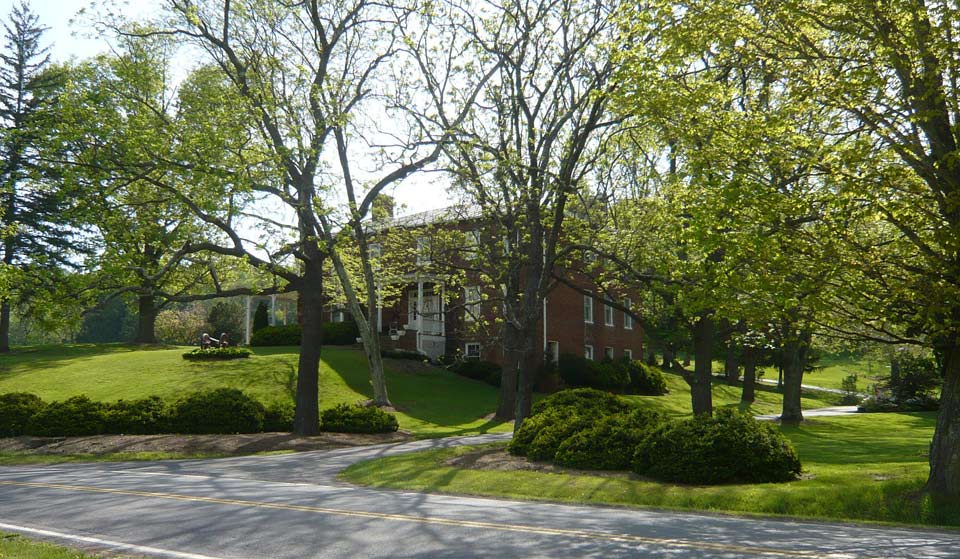
George Washington Stump was born March 8, 1821 in Hampshire County and was the forth generation of his family to live in the South Branch Valley. He was the  son of Adam and Mary Gregg (Parsons) Stump. He grew to manhood in Hampshire County, but never married. By the beginning of the war he had become a successful farmer. In 1860 he owned $10,000 worth of real estate and $6,200 in personal property. He was also the owner of four slaves.
His first record of service with the Confederacy was when the Hampshire County Militia was ordered out on July 13, 1861 by Governor Letcher to defend the state against a feared northern invasion. The following day he enlisted as a Private at Romney in Company A of the 77th Virginia Militia, commanded by Captain Philip Hartman. However, he was listed as AWOL on their roster for November and December of that year. The reason may have been that he was absent raising a company of cavalry for service in the regular Confederate army. He would equip this company largely at his own expense, and it would go through several different official designations during the war. While it was raised mostly in Hampshire County, more than fifty members were from neighboring Hardy County.
Stumps first record in the regular Confederate cavalry was when he enlisted on August 20, 1862 in Hampshire in Colonel John D. Imboden's 1st Regiment of Virginia Partisan Rangers. This regiment was recruited largely in western Virginia. Imboden would have so many volunteers for this unit that it would be divided into two regiments, the 62nd Virginia (Mounted) Infantry and the 18th Virginia Cavalry. The company Stump raised would become 1st Company G of the 62nd and on September 6, 1862, he would be appointed its Captain. When the 18th Virginia Cavalry was formed a few months later, his company would become Company B of that regiment. It would remain a part of this regiment for the remainder of the war.
Even though Stump's company was now officially part of the 18th Virginia Cavalry, it would often operate independently of the rest of the regiment. On more than one occasion it would join with McNeill's Rangers, in attacks on Union forces in Hardy and Hampshire Counties.
Captain Stump was described as a large man, more than 6 feet tall and weighing about 240 pounds. During the war he would be nicknamed "Stumps Battery" by his 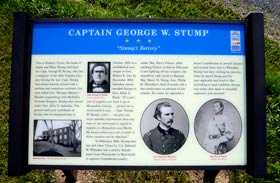 men because of the number of weapons he carried, usually at least two pistols and a seven shot carbine, and the speed with which he fired them in battle. men because of the number of weapons he carried, usually at least two pistols and a seven shot carbine, and the speed with which he fired them in battle.
In addition to being a brave and ferocious fighter, he was held in high regard by his superiors and fellow officers. Lieutenant John Blue, writing after the war said, "Captain Stump was a man of more than ordinary intelligence and but seldom erred in his judgement, brave to a fault, but cautious at all times. I knew him well, had been with him on more than one scout, and was always ready to submit to his judgement and follow his lead at any time." General Thomas J. "Stonewall" Jackson described him as, "a dependable officer, devoid of fear."
Captain Stump received a severe wound in the neck near Forrestville, Virginia on February 24, 1864. He would spend most of the following year in Rockingham County, Virginia recovering from this wound. When Union forces occupied that area late in 1864, he was forced to return to the safer area of western Virginia to complete his recovery.
Captain Stump, despite not having fully recovered from his wound would return to duty in early 1865 and by February he would be back in Hampshire County. On February 5 he decided to visit his ageing parents who were staying with their youngest son, William B. Stump. William had been a Private in Company B of the 77th Virginia Militia early in the war, but had been discharged for medical reasons.
What happened when he attempted to visit his family on the morning of February 5 is where the stories differ.
When Captain George W. Stump rode up to his brothers home early on the morning of February 5, 1865, he was planning on a peaceful visit with his parents. 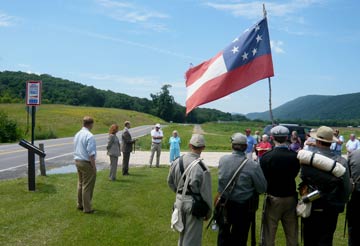 Instead he was riding to his death. Instead he was riding to his death.
Confederate and Union versions differ as to what really happened that morning, but both agree on one thing, that the men who captured and murdered Captain Stump were Union soldiers known as "Jesse Scouts." These men usually dressed in Confederate uniforms or in civilian clothes and acted as spies and messengers. Posing as Confederate soldiers or civilian supporters of the south they were able to travel through the countryside and talk to local residents in order discover troop movements and to locate and capture soldiers who were home on leave. They were commanded by Major Henry H. Young, who was General Philip Sheridan's chief of scouts. As a member of his staff, Young reported directly to Sheridan.
On the morning of February 5, Major Young was leading a force of 15 Jesse Scouts and 300 members of the 1st Connecticut Cavalry. They were returning from a quick raid into the South Branch Valley where, just outside of Moorefield, they had captured Major Harry Gilmor. When they learned that Captain Stump was in the area, they decided to attempt to capture him also.
There are actually two slightly different Confederate versions. One has Captain Stump already being at his brothers home when the enemy arrived there about daylight. At first they were mistaken for Confederates and this caused Captain Stump to delay attempting to escape. As he was riding away, he was fired upon and struck in the body and knocked from his horse. He told his captors he was a Confederate officer and that he needed medical aid. He also asked to see his parents, which was refused, he was placed back on his horse and they started for nearby Romney. Just a few minutes later his family heard a volley of shoots from that direction. When they investigated, they found his body lying in the road. He had been shot eight times and his head had been shattered with a fence rail. The rail was lying near the body and was kept in the Stump family for several generations before being lost.
The other Confederate version differs in that it places the Jesse Scouts already at the house when Captain Stump rode up. It stated he dismounted, and had reached the porch before he heard strange voices and realized they were the enemy. As he tried to escape, they fired at him, knocking down his horse and he fell onto the frozen ground. When he tried to get up, he was shot in the side. They then started toward Romney with him, but after going only a short distance, his wounds made him too weak to ride. At that time Major Young asked what was wrong and was told "he was sick", to which he replied, "make him sicker." Then he was shot and left in the road.
After the war, Sergeant George D. Mullihan, writing in the History of the Seventeenth Regiment Pennsylvania Volunteer Cavalry, gave his version of what happened. In it he describes Captain Stump as, "one of McNeill's scouts, with the reputation of hanging and cutting the throats of Union prisoners." Mullihan had been a member of this regiment until he was detailed to serve as one of the scouts under Major Young. He states that he stopped at a house to try to get something to eat and discovered it was the home of Captain Stump. After telling the Negro woman that served him that he had important dispatches for the captain, he was told Stump was attending church about a half a mile away. When he and four other scouts got to the church and asked for Captain Stump, they were told he was at his brothers. Leaving two men at the church, he then went to Captain Stumps brothers' house.
In describing Stumps capture, Mullihan said: "The house was built with a large basement and, as Nick Carlisle and myself went in the lower part of the house, we heard a noise upstairs. Running up as fast as we could, we discovered Captain Stump in the act of mounting his horse, I ordered him to surrender. While in the act of mounting his horse, we fired several shots, and he fell forward to the ground. He tried to regain his feet, and reached for his revolver. But we were upon him before he could use it, and I pointed my revolver in his face and forced him to his knees. We immediately disarmed him. His belt was supported with two straps over his shoulders, and on that belt he carried three pistols, and on his saddle he had a pistol and a seven shot carbine. I asked where he was hurt? He said in the thigh, pointing to the place." Mullihan goes on to say that he asked him if he was Captain Stump and he said no, he was his brother and that on the way down the lane toward the road he attempted to grab Nick Carlisle's revolver, but did not succeed. He was then forced to ride between them and told that if he attempted to get away, they "would make a sieve out of him."
When they caught up with the column, Major Young asked whom they had captured. Mullihan replied, "Captain Stump, but he will not own up to it." Stump finally admitted who he was and Major Young told Stump: "I suppose you know that we will kill you. But we will not serve you as you have served our men, cut your throat or hang you. We will give you a chance for your life. We will give you ten rods start on your own horse, with your spurs on. If you get away, all right. But remember, my men are dead shots." Mullihan goes on to say that "Captain Stump smiled, rode out, and we gave him the word 'Go'. We allowed him about ten rods start, then our pistols cracked, and he fell forward, dead." admitted who he was and Major Young told Stump: "I suppose you know that we will kill you. But we will not serve you as you have served our men, cut your throat or hang you. We will give you a chance for your life. We will give you ten rods start on your own horse, with your spurs on. If you get away, all right. But remember, my men are dead shots." Mullihan goes on to say that "Captain Stump smiled, rode out, and we gave him the word 'Go'. We allowed him about ten rods start, then our pistols cracked, and he fell forward, dead."
Captain Stump was buried just a short distance from where he was murdered. This small family cemetery is located on the east side of the road about a mile south of the junction of Rt. 50 and the River (Trough) Road. A large stone with his name and the names of his parents and siblings is visible from the highway.
Despite the brutal murder of Captain Stump, General Sheridan continued to support Major Young and his scouts, praising them for the information they provided and even recommending Major Young be given a brevet promotion to lieutenant colonel. After the war was over, Sheridan was sent to New Orleans and put in command of U. S. forces along the boarder with Mexico. Young and several of his scouts went with him.
Young soon resigned from the army and formed his own contingent of mercenaries. In the winter of 1866-67 while leading his men against Archduke Maximilian of Austria, who France had installed as ruler of Mexico, he was killed. The details of his death remain a mystery, but one report states he was captured and hanged. Perhaps justice was finally served.
The killing of Captain Stump was murder, no matter which version is correct. Readers can decide for themselves which one they believe. But as all good Confederates know, "those Damn Yankees lie!"
Part 1 was printed in the Moorefield Examiner on April 20,2005.
Part 2 was printed in the Moorefield Examiner, April 27, 2005. Article also had pictures of the home where Stump was captured, monument marking his grave and picture of Major Young who ordered his death.
| 
 www.HistoricHampshire.org